
Virginia Code §9.1-913 provides the statutory frame for public registry information.
Virginia Official Registry Search
The official Virginia State Police registry provides the limited-purpose search.
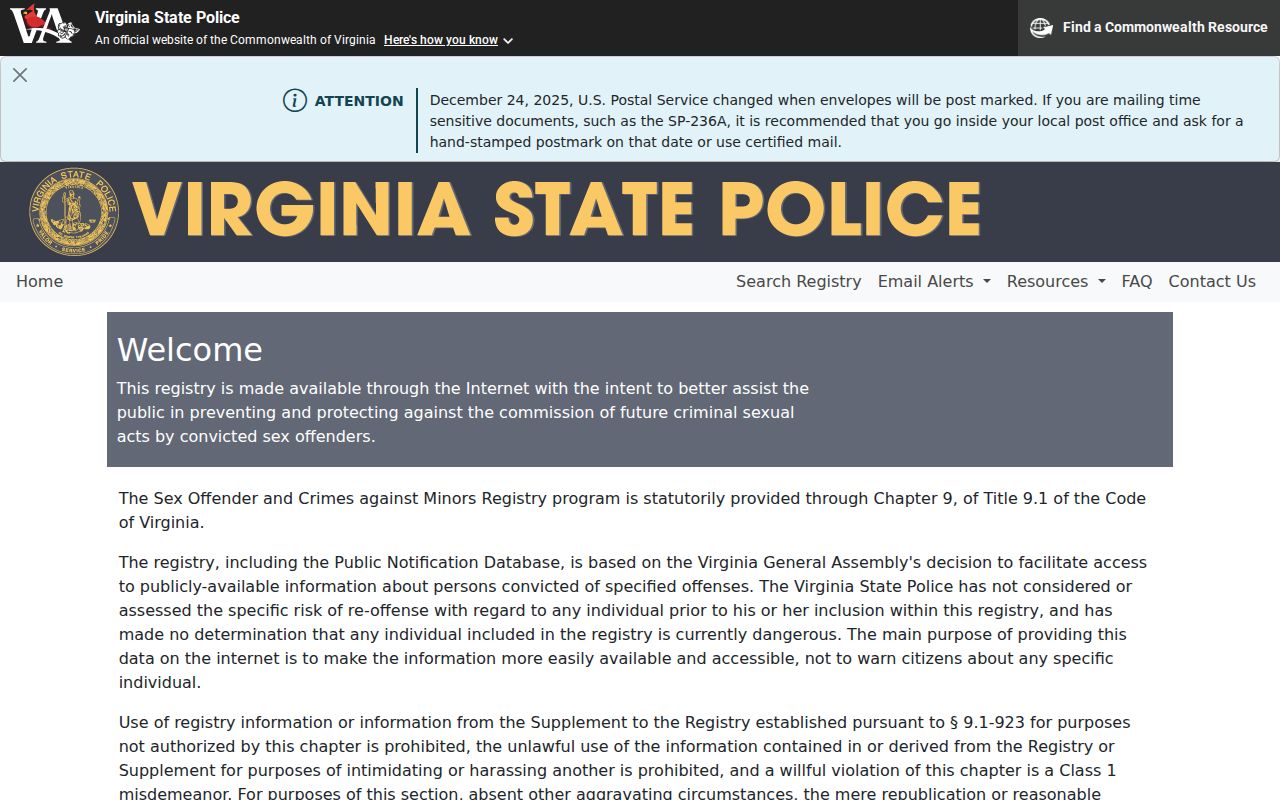
The captured registry is not a general list of people released from custody.
Registry Record Date Checks
Date a registry result when it is viewed. Virginia reports business-day updates, but a court, jail, supervision office, and registry may record different events on different days. Compare conviction locality and date, identity fields, and current published information. A current address cannot establish when custody ended.
If an entry changes or disappears, use the registry contact route for that question. Use ACRJ, VADOC, or the court for the release question. Keeping records apart makes corrections easier and prevents a limited statutory record from becoming a false custody history.
Virginia Registry Record Scope
The Virginia State Police registry applies only to people with a legal duty to register. That limited group can include some people who completed incarceration and live in Albemarle County. Many released people have no registry duty and will never appear. A no-result screen therefore says nothing about whether someone left ACRJ or VADOC.
For covered registrants, the public record may include name and aliases, age, current address, conviction date and locality, an offense summary, photograph, qualifying educational enrollment information, and a wanted-for-failure-to-register indicator when applicable. Virginia reports that the registry is updated each business day and that known inaccurate information must be removed.
| Registry field | What it can show |
|---|---|
| Name and aliases | Identity information used in the registry record |
| Address | Published current registration location as allowed |
| Conviction details | Covered offense summary, date, and locality |
| Photograph | Registry identification image, not proof of current custody |
| Compliance indicator | Registry-specific status, including a listed failure-to-register concern |
Search Albemarle Registry Records
Use the official registry rather than a copied list. Search by name, geography, and the filters the current interface provides. Compare aliases, age, photograph, address, and conviction locality before deciding that a result belongs to the intended person. Similar names are not enough.
- Open the official Virginia State Police registry and choose the most specific available search method.
- Enter the exact name and use Albemarle geography only when it helps narrow the result.
- Open the matching record and compare multiple identifiers.
- Read the registry notices and note the date of the search because records can change.
- Use the proper jail, VADOC, court, or supervision source for any question outside registry status.
A registry address does not mean the person is free of supervision. A photo does not establish current custody, guilt in a different case, or current conduct. The registry itself warns against treating inclusion as an individualized state assessment that someone is presently dangerous.
Registry Release Contact
The registry is operated by Virginia State Police, not by ACRJ, the Albemarle Sheriff, or VADOC District 9. Use the contact and correction instructions published on the live registry for questions about a public entry. The research did not document a separate Albemarle registry office or street contact, so no local institution should be invented.
Virginia Sex Offender and Crimes Against Minors RegistryVirginia State Police statewide system
No detention facility in Albemarle County
Use the official registry contact route
Registry records only
If a record appears wrong, report the concern through the official registry process. Do not ask the county jail to edit a State Police registry entry. Likewise, a booking or release record request goes to ACRJ for the local episode or VADOC for state custody. Each custodian controls its own record.
Virginia Code §9.1-913 governs the public registry framework and listed data. Read the current law and site notice when precise access or correction duties matter. The registry’s business-day update cycle does not guarantee that every outside court or custody system changes at the same moment.
Registry Versus Release Records
A release record connects one custody episode to an exit. It can show the booking or prison identifier, release date and time, method, and transfer destination if recorded. A registry record describes a continuing registration duty and selected public identifying information. The two records can coexist, but neither replaces the other.
| Question | Use this source |
|---|---|
| When did the person leave ACRJ? | ACRJ booking and release record |
| Did a state prison release occur? | VADOC locator and discharge record |
| Is community supervision active? | VADOC locator, District 9, and court order |
| Is there a current registration duty? | Virginia State Police registry |
| What did the judge order? | Relevant court record |
A person may complete incarceration but remain on the registry. Another person may complete incarceration and supervision without any duty to register. A registry entry can also remain while no current jail or prison custody exists. Use precise language for each state.
The Albemarle County release-record search gives the local, state, court, federal, and notification sequence for a named person. The registry is one specialized branch of that wider path.
Registry and Supervision Status
Registration and probation or parole are different legal duties. Probation is court-ordered community status, while parole is conditional release for an eligible prison term. VADOC supervises qualifying people through district offices. Virginia State Police operates the registry. A person can be subject to one, both, or neither.
Do not treat a registry address as the reporting office for probation or parole. For Albemarle-area VADOC supervision, search the VADOC locator and look for Charlottesville District 9. The court order states the supervision term, while District 9 can explain its procedure. Final discharge from supervision does not necessarily end a separate registry duty.
- Registration
- A statutory duty to provide and update specified information with the responsible registry authority.
- Compliance
- Registry-specific performance of the reporting duty; it is not the same as sentence completion.
- Supervision
- Probation, parole, or post-release rules administered through the court and corrections system.
- Custody
- Confinement or other legal control by a jail, prison, or detention authority.
Check each status in its own official system. Combining them into one label obscures what the record actually proves.
Registry Photograph Meaning
The public registry can display a photograph for people required to register. That image is not a general ACRJ booking-photo archive. It should not be used to infer the date of a local arrest, whether an ACRJ booking occurred, or whether the person is now confined. It serves identification within the registry record.
ACRJ does not publish a public mugshot gallery in the official channels reviewed. A local booking image, if a nonexempt responsive record exists, must be requested separately from ACRJ and reviewed under Virginia law. VADOC records follow another route. Never substitute the registry photo for the record created by the relevant custodian.
A photograph can also become outdated as appearance changes. Compare the full set of identifiers. Avoid republishing the image without context, and do not imply guilt from the existence of a photograph.
Note: A Virginia registry photograph identifies a covered registrant and does not certify an Albemarle jail release or present custody.
Registry Notifications Differ
Virginia uses separate notification tracks. Virginia Jail VINE covers participating local and regional jail events. VADOC’s NAAVI handles eligible state-prison victim notifications. Sex-offender-registry alerts are separate again. Registration in one system does not automatically enroll a person in the others.
An ACRJ-to-VADOC transfer can require a new state notification registration. A registry alert serves a different purpose from custody release notice. Keep a record of the person, jurisdiction, and system used for each registration. Otherwise, silence from one channel may be mistaken for the absence of an event handled by another.
Virginia Jail VINE is open for specific-person local custody checks. NAAVI is eligibility-gated for victims and certain family members. The registry’s current alert options should be confirmed on its official site. None replaces the public court record or an agency release record.
Correcting Registry Release Assumptions
A registry match cannot answer when the person left ACRJ, whether a VADOC sentence ended, or whether federal or ICE custody followed. Start with the agency that held the person. Use the court for the legal disposition. Then use the registry solely to confirm current public registration information for a covered person.
When sources conflict, compare dates and record purpose. A jail release entry may be years old while a registry address is current. A court conviction record may explain the duty without showing today’s address. A VADOC locator may show active supervision at a district office. These can all be accurate at once.
Document the date of each search and return to the originating office for correction. A copied third-party profile can lag after an official record changes and should not override the State Police source.