
VADOC Official Release Locator
The official VADOC locator supplies the statewide name and ID search.
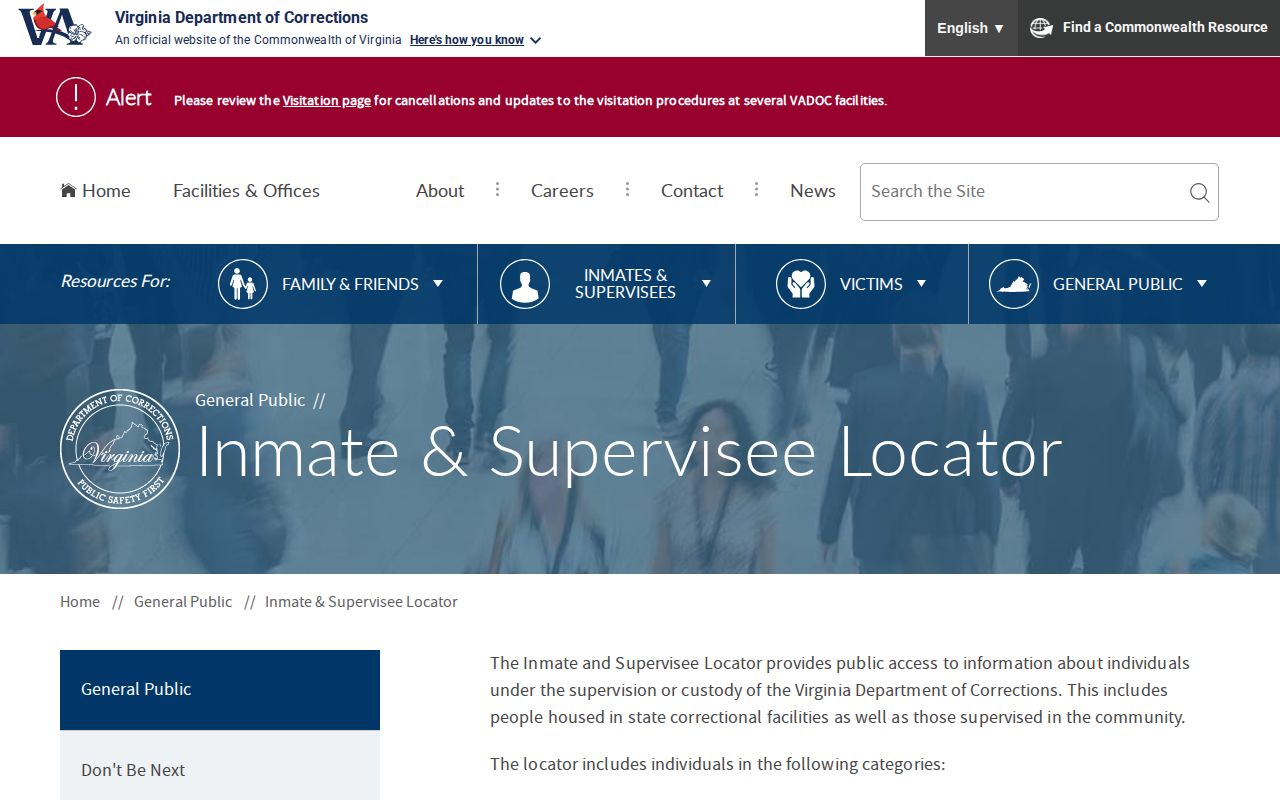
The captured locator shows the entry point used for a state-responsible person.
Albemarle State Release Evidence
A complete Albemarle state-corrections timeline often needs three records. The court judgment identifies the sentence and whether terms run together or one after another. VADOC computation applies prior confinement credit, the correct credit regime, discipline, holds, and later orders. The release or discharge record then establishes the completed event. A locator screen is useful between those steps, but it is not a signed judgment or permanent archive.
Some state-responsible people remain physically in a local or regional jail. Their location looks local while VADOC controls the calculation. Ask which authority is responsible before seeking a date. ACRJ Records answers only within its published local scope. VADOC controls state-responsible time.
After release, District 9 may confirm Albemarle-area supervision. If the locator later stops showing the person, request discharge information and retain the court order. Final discharge, release on parole, and release to probation are separate outcomes. Preserve the exact agency wording.
Where VADOC Releases Go
Virginia Department of Corrections is a statewide system. No adult VADOC prison was identified inside Albemarle County in the official directories reviewed. An Albemarle sentence can still place someone in VADOC legal custody at an institution elsewhere or in a local or regional jail for a period. Geography does not decide which locator applies. The sentence and controlling authority do.
When a state sentence is satisfied, VADOC describes the person as discharged or released on parole. The next status may be probation, parole, post-release supervision, interstate supervision, or final discharge. A district-office assignment in the public locator points to community supervision, not confinement in a prison. Final discharge means the applicable custody and supervision term has ended, though the underlying court record remains.
| VADOC status or location | Meaning |
|---|---|
| State institution | Still incarcerated in VADOC custody |
| Local or regional jail | Physically local but under a state-responsible track |
| District probation/parole office | In the community under supervision |
| No current locator result | Not proof of discharge; use records and court history |
Search VADOC Release Status
The official VADOC Inmate and Supervisee Locator covers people in state institutions, people supervised through district offices, institutional hospitals, some people housed in local or regional jails under VADOC authority, and Community Corrections Alternative Program participants. It is broad, but it is not advertised as a complete archive of every fully discharged former prisoner.
- Enter at least the first three letters of the first name and the full last name, or enter the seven-digit DOC ID.
- Use optional location, race, gender, and age-range filters only to separate similar results.
- Accept the disclaimer, complete the CAPTCHA, and compare the identifiers on each possible match.
- Read the exact institution, office, status, and date labels. Do not translate a district office into prison custody.
- Save the date of the lookup and seek a VADOC record when the result disappears or conflicts with a court order.
VADOC says the locator is updated daily but warns that information can be inaccurate or out of date. A person who only had an ACRJ booking and never entered state authority may never appear. The Albemarle County release search explains the local route for that separate case.
VADOC Release Record Contact
A state-prison episode calls for VADOC records, not ACRJ’s booking file. Identify the full name, seven-digit DOC ID if known, institution, date range, and exact discharge or release fields sought. VADOC’s public-record procedure explains how it handles criminal-justice status information and other records subject to exemptions.
Virginia Department of Corrections Central Office / FOIAP.O. Box 26963
Richmond, VA 23261
804-674-3000
FOIA@vadoc.virginia.gov
Use the official VADOC FOIA page for current directions. A request should distinguish the calculated date shown before release from the actual discharge date and method. If community supervision followed, ask for the relevant public status fields without requesting unrelated protected case material.
The criminal court remains the source for the sentence, revocation, and final order. VADOC applies custody credit, sentence order, statutory credit, discipline, detainers, and other events to calculate its date. Neither office can replace the other’s record.
VADOC Release Date Meaning
A court sentence date, a calculated release date, and an actual release event are not interchangeable. The court creates the legal term. VADOC applies presentence credit, the type and length of each sentence, the order of consecutive or concurrent terms, earning-class history, discipline, and later events. The institution then records the physical release or transfer.
The VADOC landing page does not expose the exact result-detail label without a live search. Read the label that appears rather than hard-coding a phrase such as “tentative release date.” A future date can change after a corrected court order, new detainer, consecutive sentence, loss or restoration of credit, program change, or a change in calculating authority.
- Projected date
- A current calculation, not proof that release occurred.
- Parole eligibility
- A date or status allowing review, not a promise of release.
- Parole grant
- A conditional board decision that may still require planning before physical release.
- Discharge
- Completion of the applicable correctional term as recorded by VADOC.
For a close date, recheck the locator and contact the proper records office. Afterward, use the discharge record to establish what actually happened.
Virginia Sentence Credit Systems
VADOC Time Computation separates older Good Conduct Allowance from Earned Sentence Credits. GCA generally applies to felony offenses before January 1, 1995 and misdemeanors before July 1, 2008. Its earning classes range from no credit to 30 days per 30 served, subject to the actual legal regime.
ESC generally applies to felonies on or after January 1, 1995. Virginia Code §§53.1-202.2 and 53.1-202.3 set eligibility and rates. Some listed offenses have a maximum of 4.5 days for each 30 served. Other eligible offenses can fall within tiers up to 15 days per 30 based on statutory classification, conduct, participation, and cooperation.
The common “85 percent” phrase is not a universal formula. At 4.5 credit days for each 30 served, the service share is about 86.96 percent of the satisfied term. Other tiers, mandatory minimums, excluded offenses, older sentences, multiple terms, lost credit, and presentence confinement change the result. Use VADOC’s calculation rather than multiplying every sentence by one percentage.
VADOC Facility Release Process
The official facility release source says the applicable Order of Release, Conditions of Probation, or Conditions of Parole is read or provided and signed on release day. Discharge or parole release is to occur by 11:59 p.m. on the release date, weather permitting. That statewide policy is not evidence of ACRJ’s daily gate schedule.
Release planning can include identification, transportation, reporting instructions, and connection with a district office. Conditions of parole or probation continue after the person leaves the institution. If the record shows District 9 in Charlottesville, the person is in a community-corrections status tied to that office, not incarcerated at an Albemarle prison.
Transfers also require care. Moving from a local jail to a VADOC institution ends one facility episode while state incarceration continues. Moving to a reentry or community setting may still leave VADOC authority in place. Read the destination and legal status together.
VADOC Notifications After Albemarle
Virginia Jail VINE and VADOC’s state-prison notification system are separate. A person moving from ACRJ into VADOC may trigger a local jail event, but that local registration does not automatically continue as a state-prison alert. Eligible victims and certain family members use NAAVI for anticipated and actual release and other post-sentencing events.
NAAVI is eligibility-gated and is not a general public alert subscription. The official pre-screen determines whether registration is available. The public VADOC locator remains the general custody and supervision search. These systems serve different roles and should not be merged.
The Virginia Parole Board also posts public meetings and monthly decision reports. A grant can precede plan approval and physical release, while a denial or deferral has a different effect. Confirm the actual exit with VADOC rather than treating a board vote as a prison gate timestamp.
Note: Re-register in the proper state system after an ACRJ transfer because local jail alerts do not automatically follow VADOC custody.