
BOP Official Release Locator
The official BOP locator is the federal release-search starting point.
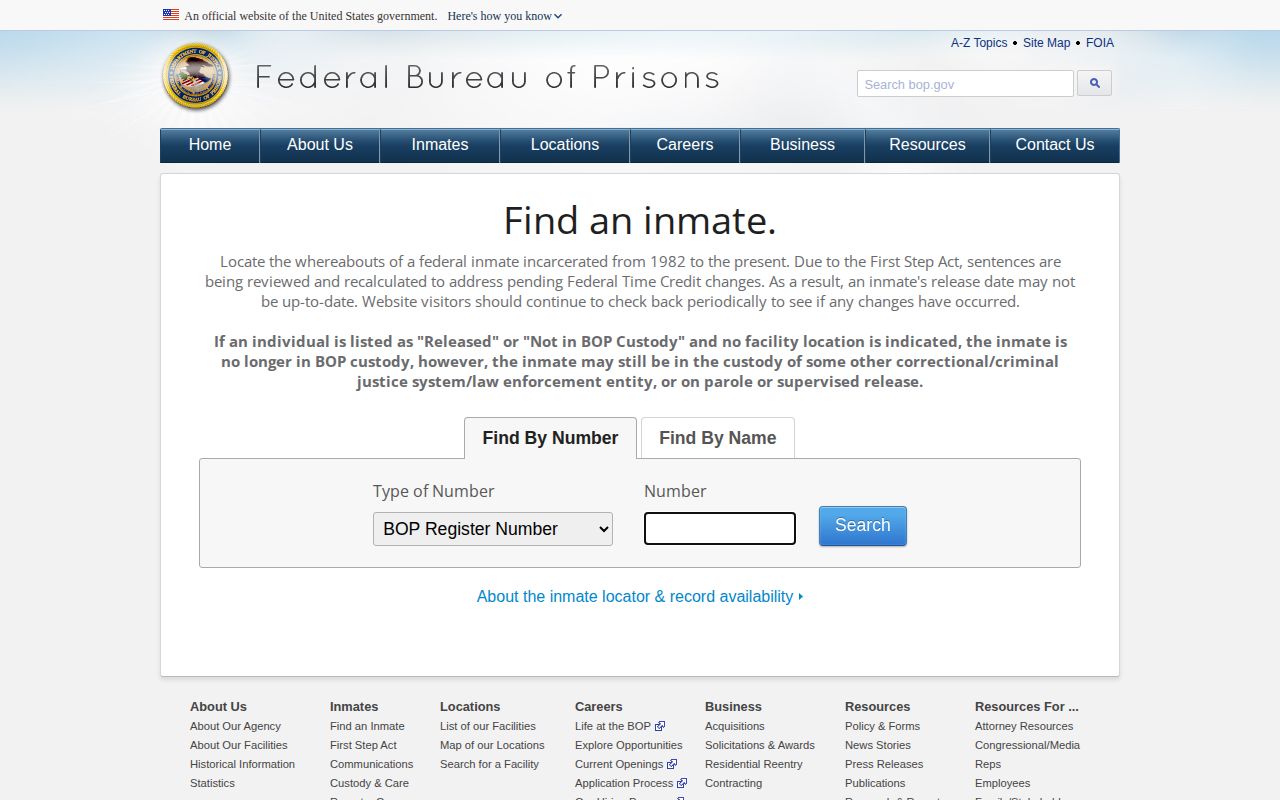
The captured page belongs to the federal system, not an Albemarle jail roster.
Federal Release Date Evidence
A BOP release date must be read with the location and status on the same result. A past date beside “Released” supports the conclusion that BOP custody ended. An unknown date may mean the term is not determined. A future date is subject to recalculation and does not prove the person left. Save the register number and lookup date so later records match the same person.
The judgment adds vital context. It can state the prison term and supervised-release term. BOP computes the custodial part, while federal probation handles supervised release after custody. A person can therefore leave BOP and still have a long court-controlled community term.
For older confinement outside the locator’s main post-1982 coverage, the National Archives route needs identity and approximate prison dates. That historical route is not proof BOP omitted a current prisoner.
Albemarle Federal Handoffs
An Albemarle link may start with a local arrest, federal writ, or temporary ACRJ housing. Ask whether the ACRJ exit was a community release or transfer. If the destination was USMS, follow the federal docket and Marshals custody. If BOP followed, the register number provides the best link between institutions and the final result.
A detainer can lead to a state, local, or immigration custodian. The BOP date remains valid for the federal episode, but the receiving record controls what came next. Keep each interval separate and in time order.
Federal Release Paths
No BOP institution was identified inside Albemarle County in the official directories reviewed. Federal relevance comes from the controlling case, not proximity. A person may pass through ACRJ temporarily under federal authority, move under U.S. Marshals custody, serve a federal sentence elsewhere, enter community confinement, and later leave BOP custody.
BOP says “Released” means no longer in BOP custody. That label does not prove freedom from federal supervised release, state custody, local custody, or immigration detention. “In Transit” is also not a release. It may reflect movement under the U.S. Marshals Service. A federal court release order can control a pretrial defendant even when no BOP prison history exists.
| Federal result | Next check |
|---|---|
| Released with date | Federal docket and supervised-release terms |
| In Transit | USMS or federal court custody path |
| Current institution | BOP custody continues |
| No BOP result | Federal court, USMS, spelling, and date coverage |
Search BOP Release Records
The official BOP Inmate Locator supports number and name searches. Use a BOP register number, DCDC number, FBI number, or INS number when available. The name route allows demographic filters to distinguish similar people. Results can show name, register number, age, race, sex, release date, and location or status.
- Confirm the case was federal through the judgment or federal docket.
- Search by federal register number for the strongest match, or use full name and identifying filters.
- Read the exact status and date. Do not treat “In Transit” or an unknown date as release.
- Check the federal court record for the legal order and any supervised-release term.
- Use BOP or USMS records when a live result does not answer the custody transition.
The locator principally covers federal incarceration from 1982 forward. Older files may require the National Archives with the full name, birth date or approximate age, race, and approximate prison dates. First Step Act recalculation can change a future displayed date, so recheck it.
BOP Release Record Requests
The BOP locator is the fastest public source, but a richer official release document may be needed. BOP Form BP-A714 contains fields for release date and method, community versus detainer disposition, destination or transportation, and reporting details. Access to a person’s complete form remains subject to federal privacy and disclosure review.
Use the BOP FOIA channel and identify the person, register number, institution if known, and date range. Ask for the specific existing release or movement record rather than a narrative answer. State whether the question concerns the actual BOP exit date, method, or destination.
The federal sentencing court holds the judgment, detention order, release order, and supervised-release terms. USMS records can matter for prisoner processing and transport. One office cannot assemble a complete cross-agency history on demand, so pair each question with the custodian that created its answer.
Federal Bureau of Prisons systemNo BOP institution identified in Albemarle County
Use the national locator and BOP FOIA contacts
Federal case authority controls the route
Federal Release Versus ACRJ
Physical presence at Albemarle-Charlottesville Regional Jail does not show which sovereign controls the next move. ACRJ’s mission allows temporary state and federal prisoners. If a federal detainee leaves ACRJ for USMS transport, the local jail episode ends while federal custody continues. The ACRJ release record should state a transfer or destination when recorded.
For the local leg, use ACRJ Records. For the federal leg, use BOP, the U.S. Marshals Service, and the federal court. Do not search the Virginia Department of Corrections solely because ACRJ no longer shows the person. VADOC is the state system and does not certify federal release.
A local criminal case and federal case can also coexist. Check both dockets when the facts support that possibility. The Albemarle County release search path explains how to separate local, state, federal, and immigration custodians.
- Federal pretrial detainee
- A person held while the federal case is pending, often under court and USMS authority.
- BOP prisoner
- A person serving or otherwise held within the federal prison system.
- Community confinement
- A placement such as a residential reentry setting that may remain part of BOP custody.
- Supervised release
- A court-ordered community term after federal incarceration, supervised through the federal court system.
Federal Community Release Status
A person can be outside a secure prison yet remain in BOP custody or under federal control. Residential reentry centers and home confinement can be forms of community confinement. Their legal effect differs from a final “Released” locator status. Ask which agency controls the person and whether the placement remains part of the sentence.
After BOP custody ends, federal supervised release may begin. It is not incarceration and should not be called a prison location. The federal judgment states the term and conditions. The federal probation office and court record are the proper sources for current procedure and formal modifications.
A detainer can also redirect the release. The BOP release record may distinguish a community disposition from a detainer destination. Follow that destination into the receiving state, local, or ICE system rather than stopping at the BOP release date.
Note: Release from BOP custody can lead directly to federal supervision or another custodian, so verify the stated destination.
USMS Release Confirmation
The U.S. Marshals Service does not provide a public historical released-prisoner locator comparable to BOP’s. A federal pretrial release is best established through the federal court docket and signed order. When prisoner movement or processing is the missing fact, the USMS FOIA process identifies relevant systems, subject to exemptions and privacy limits.
If BOP shows “In Transit,” investigate the USMS and court path. Do not infer that travel means release. The person may be moving between facilities, appearing in court, or awaiting designation. Likewise, a pretrial defendant may never appear as a sentenced BOP prisoner.
The strongest file usually pairs the court’s legal order with the agency record for physical custody. Record the date of any online search. Federal databases can update on different schedules, and future dates can move.
Federal and ICE Separation
An INS number can be used as one BOP search identifier, but that does not turn BOP into the ICE detainee locator. Criminal federal custody and civil immigration detention are separate systems. A person released by BOP can be transferred to ICE, and the BOP result alone will not certify release from immigration custody.
When a detainer or immigration transfer appears, check the official ICE locator and the relevant ICE office. When the record shows state or local destination, follow that receiving agency. A release date from one custodian always needs context from the next custodian when a handoff occurred.