
ACRJ Official Release Gateway
The official ACRJ gateway identifies the jail and its outside inmate-locator route.
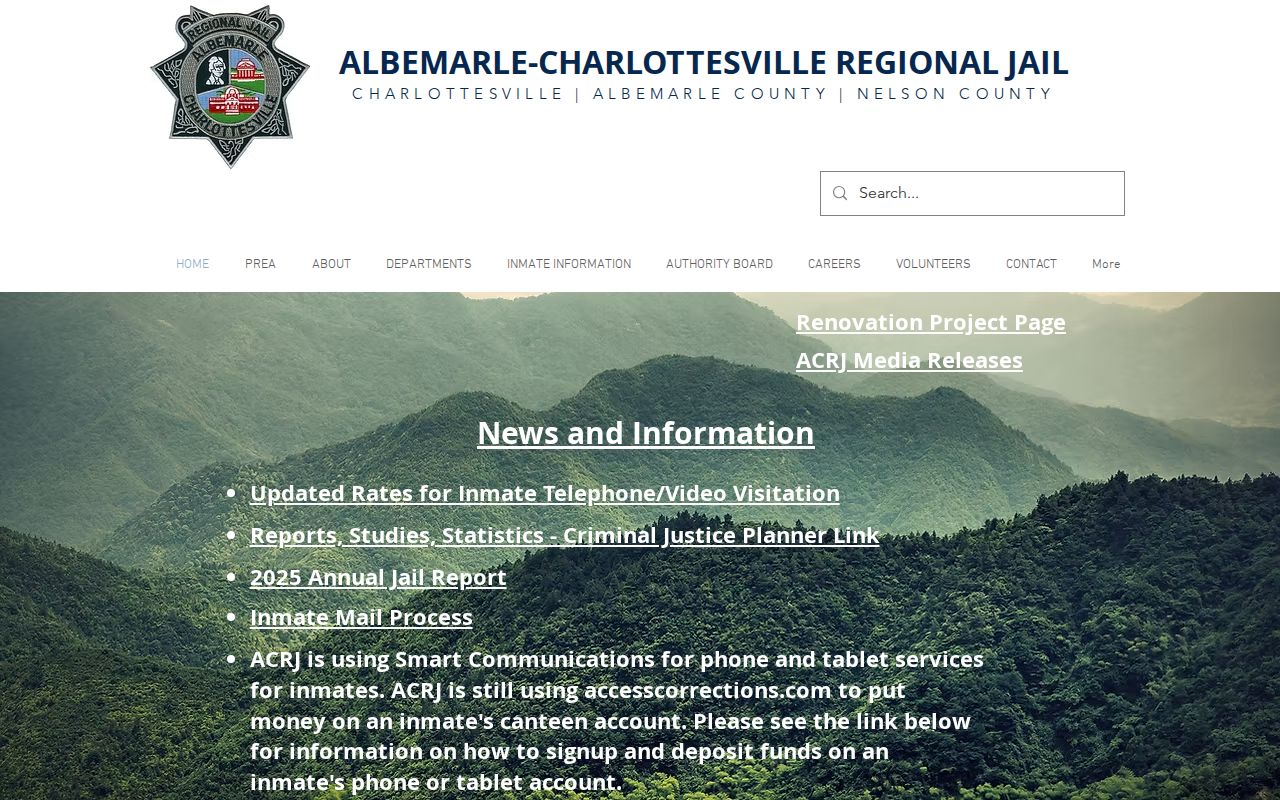
The captured page confirms that ACRJ, not a sheriff roster, is the local facility source.
Where ACRJ Releases Go
Albemarle-Charlottesville Regional Jail is the principal local jail for Albemarle County arrests and local sentences. It also serves Charlottesville and Nelson County. Leaving ACRJ can mean release on secured or unsecured bond, personal recognizance, a pretrial arrangement, time served, sentence completion, or another court order. Those outcomes place the person in the community, though probation or pretrial supervision may still apply.
Not every exit is a community release. A person may move to a Virginia Department of Corrections institution, another local jail, federal or immigration custody, a hospital, treatment, or another authorized placement. Death also ends a live custody listing. The release or transfer disposition matters more than mere absence from a screen. A VINE event may provide a fast lead, but the episode-specific jail record supplies the recorded date, time, and destination if that field exists.
| ACRJ exit | What to verify next |
|---|---|
| Bond or recognizance | Court order, ACRJ release entry, and any OAR pretrial assignment |
| Sentence served | ACRJ release time and any probation order |
| VADOC transfer | VADOC Inmate and Supervisee Locator |
| Federal or ICE transfer | BOP, federal court, USMS, or ICE record as applicable |
Confirm an ACRJ Release
ACRJ does not publish a native name roster or rolling recent-release table. Its official Inmate Locator points to Virginia Jail VINE. That service is designed for a specific-person custody check and alerts. It is not a certified list of all people who left during a chosen period. A negative result alone is weak proof because spelling, display limits, a transfer, or a closed episode can explain it.
- Search the person through the ACRJ-linked Virginia Jail VINE route. Compare the reporting agency and identifiers, not just the name.
- Read the event language. Treat “transfer” as continuing custody and identify the receiving system.
- Check the Albemarle General District or Circuit Court case for the legal disposition or release-related order.
- Ask ACRJ Records for existing booking and release entries that show the actual exit date, time, and disposition.
A court order and a jail entry answer different questions. The judge’s record proves what was ordered. ACRJ’s record shows when physical processing ended. For a broader explanation of that two-record method, use the Albemarle County released-inmate search and records coverage.
ACRJ Release Records Contact
The ACRJ Records Department prepares and maintains records for people confined at the jail. It is the direct office for qualifying local sentence and release questions within its published scope. Records can address jail terms of 12 months or less when no other detainer or pending matter exists. State-responsible calculations belong to VADOC.
Albemarle-Charlottesville Regional Jail Records160 Peregory Lane
Charlottesville, VA 22902
434-977-6981, extension 303
Monday through Friday, 8:30 a.m. to 4:00 p.m.
For existing documents, the jail’s FOIA channel names Theresa Schwab at extension 268 and foiarequests@acrj.org. Identify the person, approximate booking date, and episode. Ask for the booking and release record, commitment and release documentation, and the recorded release or transfer disposition. Electronic delivery and an advance cost estimate can keep scope clear. No fixed ACRJ fee for this record was published.
Virginia FOIA generally requires an initial response within five working days, though the law allows stated extensions and does not promise production within that first period. Charges may reflect reasonable actual costs. A narrow request is more useful than asking staff to research a person’s full history.
ACRJ Court-Order Release Lag
ACRJ states that it cannot process release until actual orders arrive directly from every court involved. Transmission can take several days. An online docket may therefore show bond, dismissal, or time served before the person has completed identity checks, paperwork, property steps, detainer review, and physical discharge.
Ask the court clerk for a disposition or sentencing order. Ask the jail for the exit record. ACRJ specifically says it does not supply warrants, court dispositions, sentencing orders, federal release dates, underlying federal charges, or a general criminal history. Each record stays with its proper custodian. This division prevents a docket entry from being mistaken for a gate time and a jail departure from being mistaken for case completion.
For a felony that moved from General District Court to Circuit Court, both dockets may be relevant. A later revocation or another court’s hold may also affect the result. Note the time of each live check and reconcile conflicting entries with the office that created them.
Note: The court proves legal authority for release, while ACRJ Records proves that the jail completed the physical exit.
ACRJ Sentence Release Calculations
Local jail dates are not safe to estimate with a simple formula. ACRJ cites Virginia Code §53.1-187 for credit tied to confinement awaiting trial. It says mandatory jail sentences do not earn good time. Felony jail release dates use the maximum good time allowed by law, but felony jail sentences do not receive extra trustee or program credit. Different rules may apply to qualifying misdemeanor time.
- Trustee judicial good time
- One day for each five days worked, submitted every two weeks and subject to court approval. ACRJ does not project it because it must first be worked.
- Program exemplary good time
- Potentially five days per 30 days in qualifying jail programming after full sentencing, at the discretion of the superintendent or designee.
- State-responsible time
- Credit and release calculations controlled by VADOC rather than ACRJ.
- Detainer
- A request or hold that may prevent release into the community even when one sentence appears complete.
Records limits date answers to qualifying terms within its stated range and only when no detainer or other pending charge exists. The office also needs all court orders. Work release and home electronic incarceration can place someone outside a housing unit while legal custody continues, so neither should be described as final release.
ACRJ Detainers and ICE Release
ACRJ’s historical document center distinguishes people who had an ICE-filed detainer from people actually taken into ICE custody. The distinction is vital. A detainer is not itself an ICE pickup, and it does not prove the person entered federal civil custody. Historical local reporting also described a community release followed by a later, separate ICE arrest. That account does not establish current policy.
After an ACRJ name disappears, use the ICE Online Detainee Locator independently when immigration custody is a real possibility. Search by A-number and country of birth or by exact biographical details. The locator is not a complete historical discharge archive, and it excludes minors from public search. A criminal-case release and an immigration-custody release are separate events.
Likewise, a federal criminal transfer calls for BOP, USMS, and federal court channels based on the controlling case. Do not label ACRJ as an ICE center or federal prison. It may hold people temporarily for other authorities, but no official source reviewed identifies it as Albemarle County’s immigration detention facility.
ACRJ History and Renovation
ACRJ opened in fall 1974 after Charlottesville and Albemarle County combined their older separate jail operations in the Albemarle-Charlottesville Joint Security Complex. It took its current name in 1996, and Nelson County is now the third named member jurisdiction. The regional history explains why the facility, rather than the sheriff’s website, controls jail records for Albemarle cases.
The current renovation project focuses on accessibility and aging building systems as well as visitation, special management, alternatives to continuous incarceration, and reentry. Albemarle’s public record cited a rated capacity of 329 and said the plan did not call for an increase. The live project hub should be checked for current construction details because schedules can change.
Renovation, work release, and home electronic incarceration also complicate visual assumptions about custody. A person may serve a sentence through an approved alternative without being finally discharged. Confirm the legal status through Records and the court, not through where someone was seen.
ACRJ Release Property Questions
The jail’s property page requires a fully completed Inmate Property Release Form before funds or property can go to a named designee. Only the named person may receive the property, and that recipient must sign. The published contact is Sgt. Scott Saberg at the main number, extension 235, or sabergs@acrj.org.
That procedure concerns property released by a confined person. The page does not state the final-discharge pickup window, discharge door, abandoned-property rule, or a standard family waiting area. A former inmate with an unresolved item should contact ACRJ, identify the booking episode, and ask which process now applies. No official source reviewed promises a set daily release hour, weekend schedule, ride service, or direct bus stop at Peregory Lane.
Note: Confirm pickup plans with ACRJ because published office hours do not establish the hour or place of an individual discharge.